What to Focus On (And Ignore) When Starting an Online Business
Starting an online business is less about doing more, and more about doing less — deliberately. The difference between progress and stagnation often comes down to what you choose to ignore.

One of the biggest reasons people struggle when starting an online business isn’t a lack of ideas.
It’s the opposite.
They have too many ideas.
Too many things they could build.
Too many traffic strategies they could try.
Too many monetisation paths that all sound plausible on paper.
And because everything feels possible, everything gets a little attention.
Which usually means nothing gets enough attention to work.
Early-stage failure is often less about choosing the wrong thing, and more about refusing to choose one thing properly.
Why Most New Online Businesses Feel Busy But Don’t Gain Momentum
There’s a type of work that feels productive but rarely creates results.
It looks like:
- researching lots of ideas without committing to one
- setting up multiple platforms “just in case”
- creating bits of content in different formats
- half-building several things at once
- changing direction every time a new tactic sounds promising
It gives the impression of movement.
But it rarely creates momentum.
And momentum is what matters most at the beginning.
Because until something starts to work — even slightly — there’s no real signal.
No feedback.
No evidence.
Just effort spread too thin to teach you anything useful.
What Happens If You Don’t Focus
This is the part people don’t always say out loud.
If you don’t focus, you can spend months being active and still end up with almost nothing to show for it.
You can:
- publish content that never compounds
- test traffic channels too briefly to learn from them
- start monetisation methods before there’s enough attention to support them
- burn energy on “business tasks” that don’t move the business forward
Which creates one of the worst outcomes in early business building:
lots of effort, no traction, and no clear idea why
That’s the trap.
Not failure.
Stagnation disguised as effort.
The Core Idea From Essentialism That Changes Everything
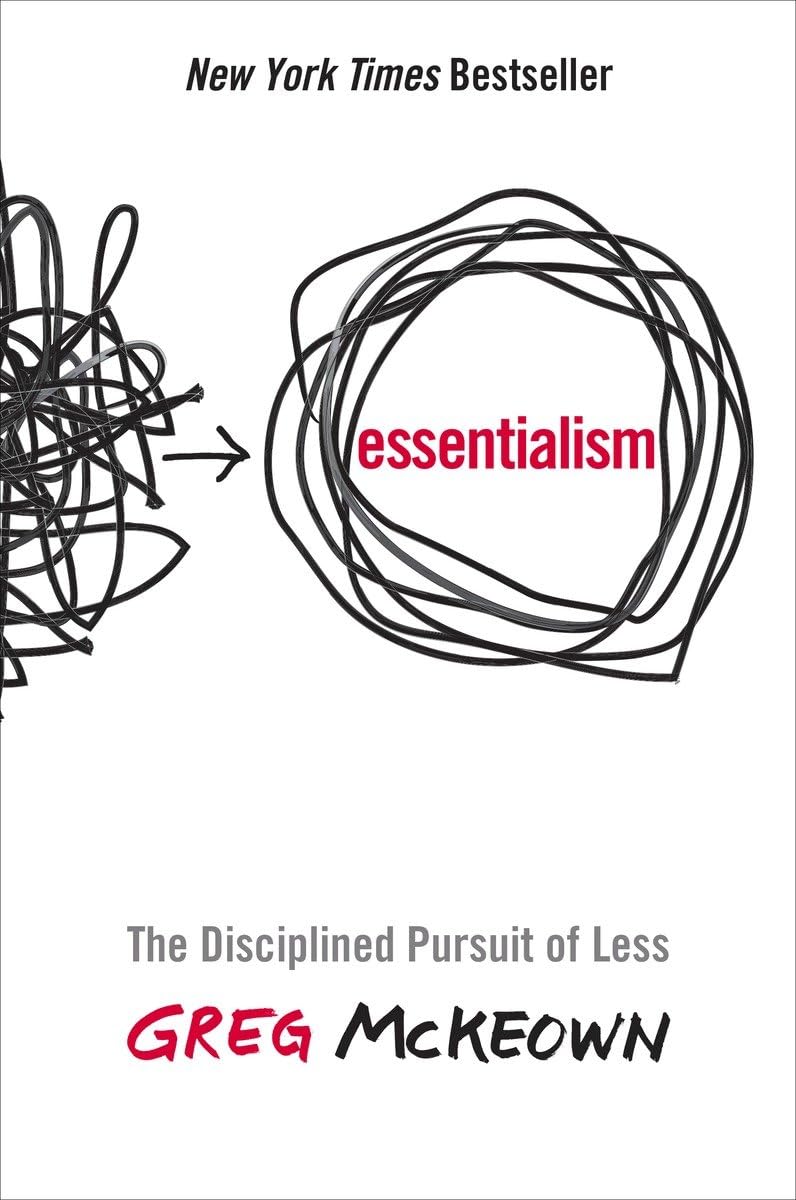
One of the most useful books on this idea is Essentialism.
The core argument of the book is simple, but brutal:
If you don’t prioritise your life, someone else will.
Applied to starting an online business, that becomes:
If you don’t choose what matters most, every good idea will compete equally for your time.
And when every good idea gets equal attention, none of them get enough attention.
That’s why essentialism matters so much in the early stage.
It isn’t just about minimalism.
It’s about disciplined elimination.
Saying:
That might work.
But not now.
That distinction is where clarity comes from.
What to Focus On First When Starting an Online Business
At a high level, the early-stage model becomes much clearer when you break it into three parts:
- Content
- Traffic
- Monetisation
Almost every online business is some version of that.
The mistake is trying to build all three in multiple directions at once.
The better approach is to narrow each one aggressively.
1. Focus on One Type of Content
Content is the foundation.
Without content, there’s nothing to:
- rank
- share
- email about
- or monetise
But “content” is too broad to be useful on its own.
The real decision is:
What format of content best fits the model I’m building?
In this case, the answer is long-form, problem-solving content published on a website.
Not because short-form content is bad.
But because long-form content:
- supports search
- compounds better over time
- can be updated and improved
- creates stronger foundations for future monetisation
This is why the early focus is on a content-led website, not trying to create content for every platform at once.
2. Focus on One Primary Traffic Channel
This is where focus becomes even more important.
It’s very tempting to try:
- X
- YouTube
But unless you have a lot of time, that becomes a distraction rather than a strategy.
The better question is:
Which traffic channel best matches the type of asset I’m building?
For a content-led site, the obvious answer is search.
Search-driven traffic makes sense because it:
- matches intent
- compounds over time
- doesn’t require constant real-time presence
- supports a structured content strategy
That’s why the primary focus is on SEO and search-led traffic, rather than trying to build an audience everywhere at once.
3. Focus on One Starting Monetisation Path
Monetisation matters — but it matters in the right order.
A lot of people either:
- ignore monetisation until too late
- or obsess over it before there’s any traffic or value
Both are mistakes.
The smarter move is to choose a starting point that:
- fits the content
- fits the traffic source
- and doesn’t require huge complexity to implement
In this case, that means starting with affiliate-style monetisation and expanding later into digital products once the system has more proof behind it.
What to Ignore at the Start
This is the part that matters just as much as what you focus on.
At the beginning, it makes sense to ignore:
- trying to master every platform
- building multiple businesses at once
- creating every possible monetisation path immediately
- spending too much time on branding before there’s traction
- consuming endless information instead of building
Not because those things are always useless.
But because they usually arrive too early.
And early complexity is one of the fastest ways to kill consistency.
Why This Matters More If You’re Not Using Paid Ads
If you’re not relying on paid ads to force traffic into the system, focus matters even more.
Paid ads can sometimes hide weak structure for a while.
Organic growth doesn’t let you do that.
Without paid traffic, the system has to be strong enough to stand on its own:
- the content has to be useful
- the traffic strategy has to compound
- the monetisation has to make sense
Which is exactly why aggressive focus matters at the start.
The Real Goal at This Stage
The goal isn’t to build the perfect business.
It’s to build the first version of a business that can actually work.
Simplicity at the start is not a lack of ambition. It’s the structure that makes execution possible.
That means:
- one niche
- one type of content
- one traffic strategy
- one starting monetisation path
Not forever.
Just long enough to create proof.
Closing Thought
Most people don’t fail because they choose the wrong strategy.
They fail because they never commit to one strategy long enough to see if it works.
If you want to start an online business without relying on paid ads, the smartest move is usually the least exciting one: cut the noise, choose the essentials, and build from there.